Saanvin Packaging Solutions Private Limited

What Are FIBC Bags ?

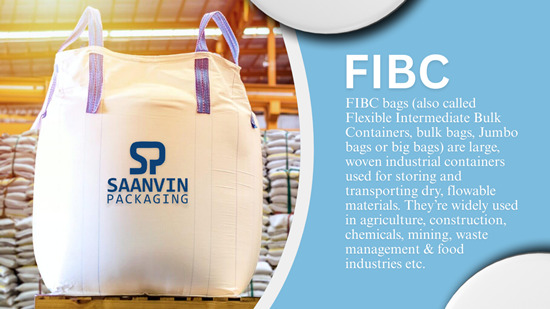
A Flexible Intermediate Bulk Container (FIBC)—also known as a jumbo bag, bulk bag, super sack, big bag, or tonne bag—is an industrial-grade container manufactured from flexible fabric and designed for the safe storage and transportation of bulk materials. FIBCs are widely utilized across various industries due to their versatility and efficiency.

These containers are typically produced from heavy-duty woven polypropylene fabric, which may be coated or uncoated depending on the application. FIBC bags are used globally as a cost-effective and reliable alternative to conventional storage and shipping solutions such as wooden pallets, rigid plastic containers, or metal bins.

FIBC bags are valued for their practicality, strength, durability, and reusability, making them ideal for bulk handling, storage, and logistics operations. Based on specific application requirements, they can be manufactured in a range of materials, designs, shapes, and sizes. Engineered to withstand substantial tensile loads, certain FIBC types are rated to safely carry loads of up to 5,000 pounds per bag.


What Are FIBC Made Of?

Manufacturers may utilize a range of materials in the production of bulk bags; however, polypropylene remains the most widely used material for manufacturing FIBC bags. Polypropylene is a petroleum-based thermoplastic that is lightweight, flexible, and woven for enhanced strength, while also being fully recyclable.

Polypropylene is an inert material, meaning it is resistant to chemical reactions, erosion, and degradation. This inherent stability contributes significantly to the durability, safety, and reusability of FIBC bags, making them a preferred choice for bulk storage and transportation. The tightly woven polypropylene fabric provides exceptional tensile strength, enabling FIBC bags to safely carry loads substantially greater than the weight of the material itself. These attributes, among others, have made FIBC bags a reliable, efficient, and increasingly popular solution within modern supply chain operations.

Benefits of FIBC Bags:

  • Cost-effective solution for bulk storage and transportation
  • High load-bearing capacity with excellent tensile strength
  • Lightweight yet extremely durable construction
  • Reusable and recyclable, supporting sustainability initiatives
  • Resistant to moisture, chemicals, and environmental degradation
  • Space-efficient; collapsible when empty for easy storage
  • Customizable in size, shape, and design to suit specific applications
  • Suitable for a wide range of industries and materials
  • Easy handling with forklifts or cranes
  • Reduces dependence on rigid containers, pallets, or metal bins

Areas Where FIBC Bags Are Most Frequently Used?

  • Agriculture (grains, seeds, fertilizers, animal feed)
  • Food industry (sugar, flour, rice, starch, salt, food-grade powders)
  • Chemicals and petrochemicals
  • Pharmaceuticals and healthcare products
  • Minerals and mining (sand, cement, ores, fly ash)
  • Construction materials
  • Plastics and polymer granules
  • Recycling and waste management
  • Pharmaceuticals and healthcare products

FIBC bags come with various Filling/Discharge/Loop options. Every customer has different requirements and uses a different style of bag.

Filling Options

  • Open top
  • Skirt / Duffle top
  • Inlet Spout
  •  Conical top

Discharge Options

  • Flat bottom (no discharge)
  • Discharge spout (standard, conical, petal or iris type)
  • Full-open bottom

Loop / Lifting Options

  • Four corner loops (standard)
  • Cross corner loops
  • Single loop (one-loop bag)
  • Two-loops bag (tubular designs)
  • Tunnel loops (sleeve lifting)
  • Stevedore straps
  • Customized loop lengths and loop reinforcement